


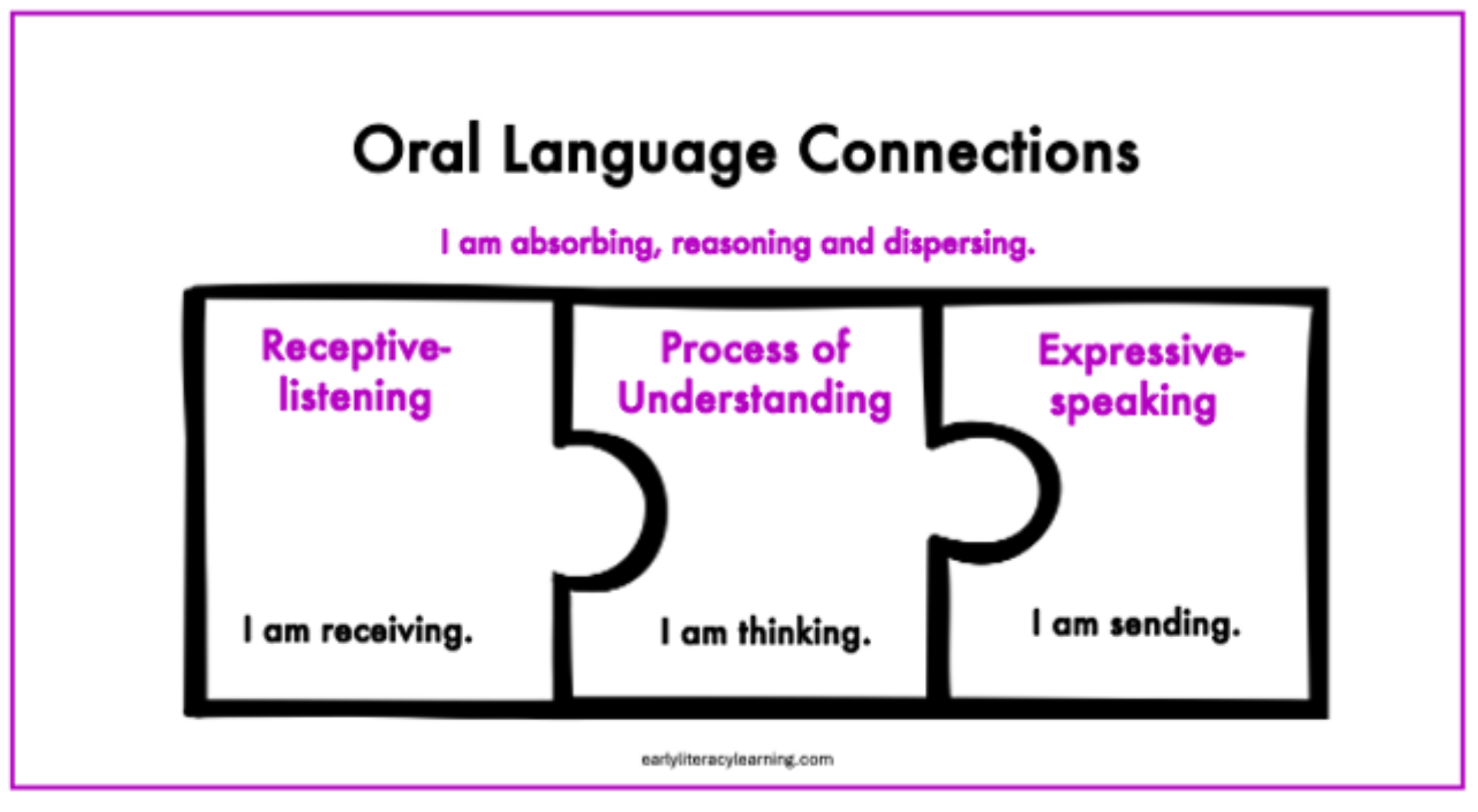
Listening & speaking are the first language skills that are introduced to a child on their quest for communication. In the middle of listening and speaking is understanding. A listener responds in words and non-verbal cues to the spoken language heard.
Listening skills do begin in the womb and start to be “fine tuned” after birth. A babys’ brain works hard to produce the sounds that lead to speaking their first words around the age of one. Toddlers enjoy manipulating sounds throughout their day as new sounds and words are introduced. Their brain is learning how to follow conversations and join in the exchange the best they can depending on age and skill level. It’s important to consider that before a child can read or write print there is an abundance of pre-readiness skills that need to be tackled by the brain that require auditory processing skills.
What is auditory processing? It’s a cognitive skill that occurs when the ears detect and transmit environmental and speech sounds heard by the brain. The brain identifies, interprets and organizes what is heard, decides what’s to be stored and/or provides a response. It’s a meaning making sound machine!
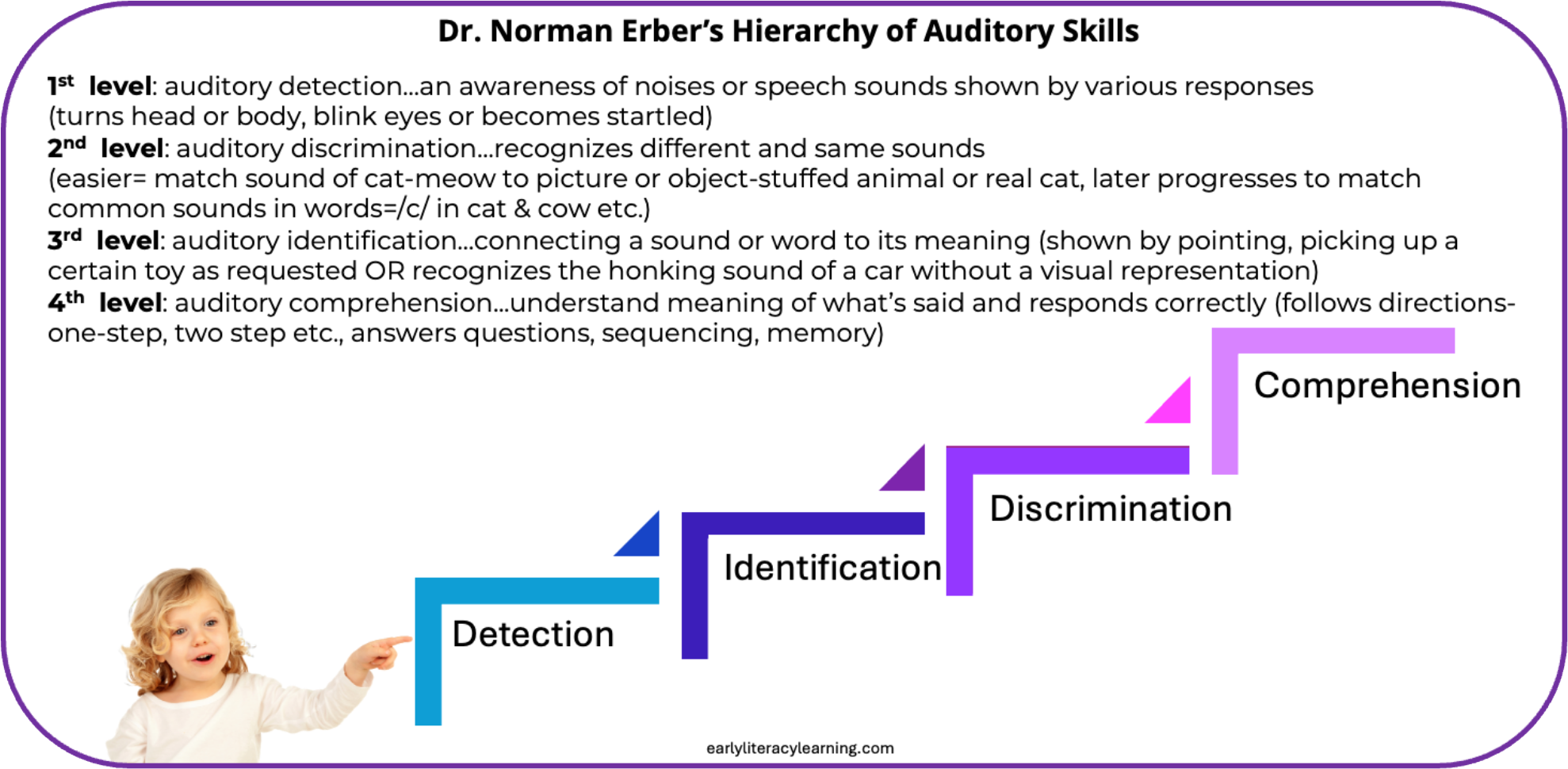
Dr. Norman Erber developed these four main levels of auditory processing called Auditory Hierarchy, sometimes referred to as the listening ladder : detection, discrimination, identification, and comprehension. The visual below shows how these levels are connected to each other and ascend in difficulty with each level providing some examples.
Besides the auditory skills mentioned by Dr. Erber there are two other ones to reference which are important for toddlers.
- Auditory attention figure-ground –the ability to focus on a specific sound called the “figure” while filtering out the background noises called the “ground”. For instance, a child learns to ignore surrounding background sounds of music when listening to what’s being said to them.
- Auditory attention — closely connected to attention figure-ground except that this is how well one sustains their focus. A two-year old average attention span is 4 to 6 minutes and a three-year old has a range 6 to 8 minutes. It does depend on the activity that the toddler is engaged with, as some toddlers may have an increased time span due to their prolonged involvement.
There are numerous activities that assist the development of a child’s auditory processing skills. Many were shared in previous sections on this website within Talking Time and Music Time. Also, other ideas and articles are listed below in the reference and resource section at the end of this blog post.
Toddlers have been using auditory processing already every day all throughout their day, true. Since they are now in the emergent stage of literacy there are specific auditory processing skills that are essential for literacy development. These first auditory skills are learned without the emphasis on print. It’s the “sharping of hearing speech sounds” that will support their future intensive phonics work of learning how speech sounds-phonemes are connected to print-graphemes. One key element that the brain depends on is its complex auditory processing skills for phonological awareness development.
Phonological Awareness (phonological sensitivity)
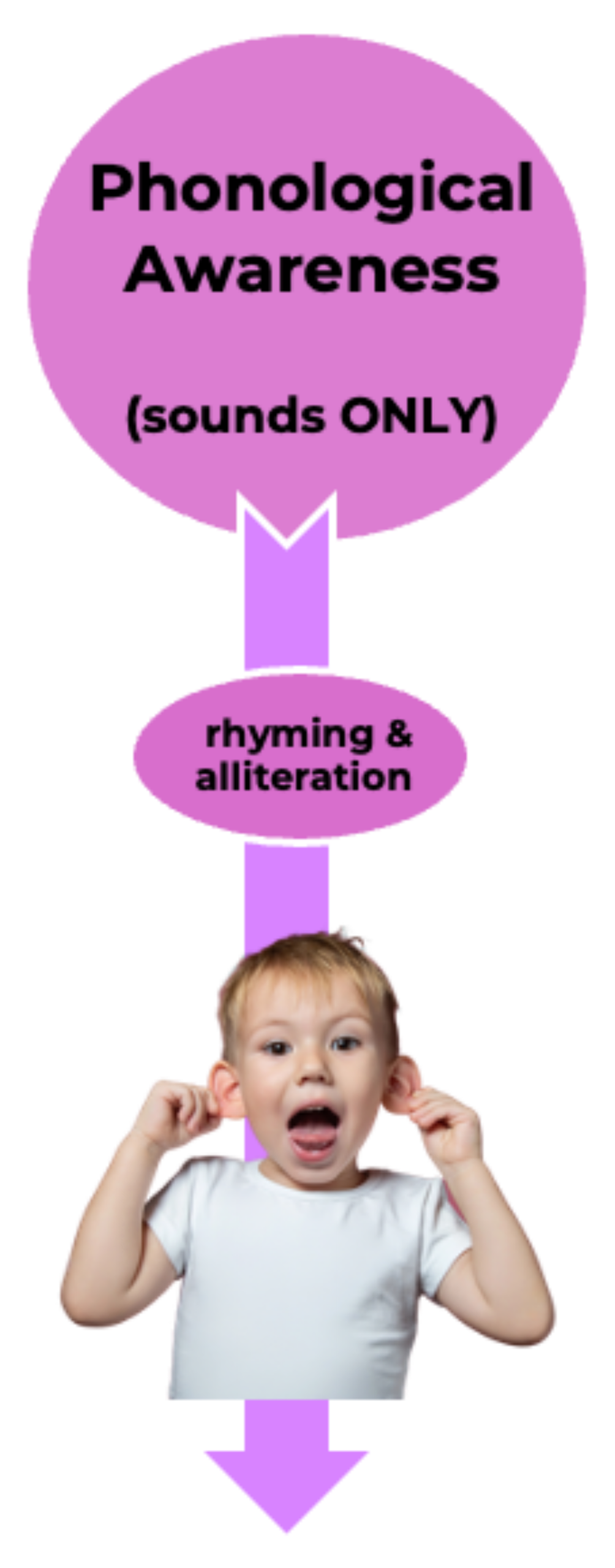
Phonological awareness is one of the main concepts for a beginning literacy learner. It’s the ability to recognize and manipulate sounds in a spoken language, without PRINT. The auditory processing skills are usually broken down into four main parts: rhyming & alliteration, syllables, onset & rime AND phonemic awareness. It’s all about the ears!
Rhyming & Alliteration (Sounds only-no print)
Rhyming activities help a young child learn to use their listening skills to hear matching ending sounds of words. These three rhyming words– bed said fed–visually do not have matching spelling parts, their ending sounds heard do match. The goal is to focus on hearing the ending sounds.
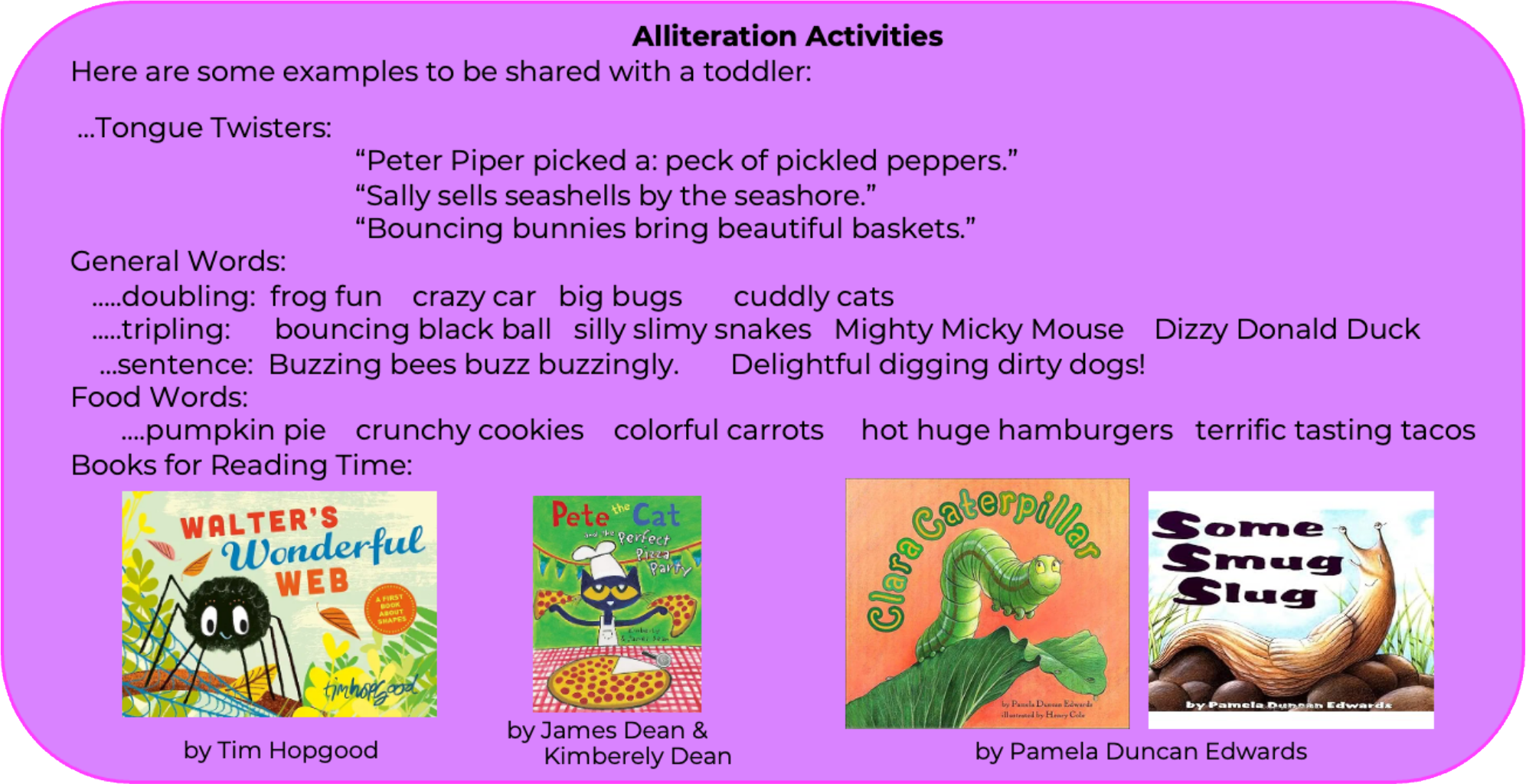
Alliteration activities assist children to learn about beginning sounds. It uses a series of words or a sentence containing multiple words that start with the same sound, for example: friendly frog, teeny tiny turtles, A colorful cow cuddles. or Silly sheep sleep silently. The goal is to focus on the hearing the same beginning sounds.
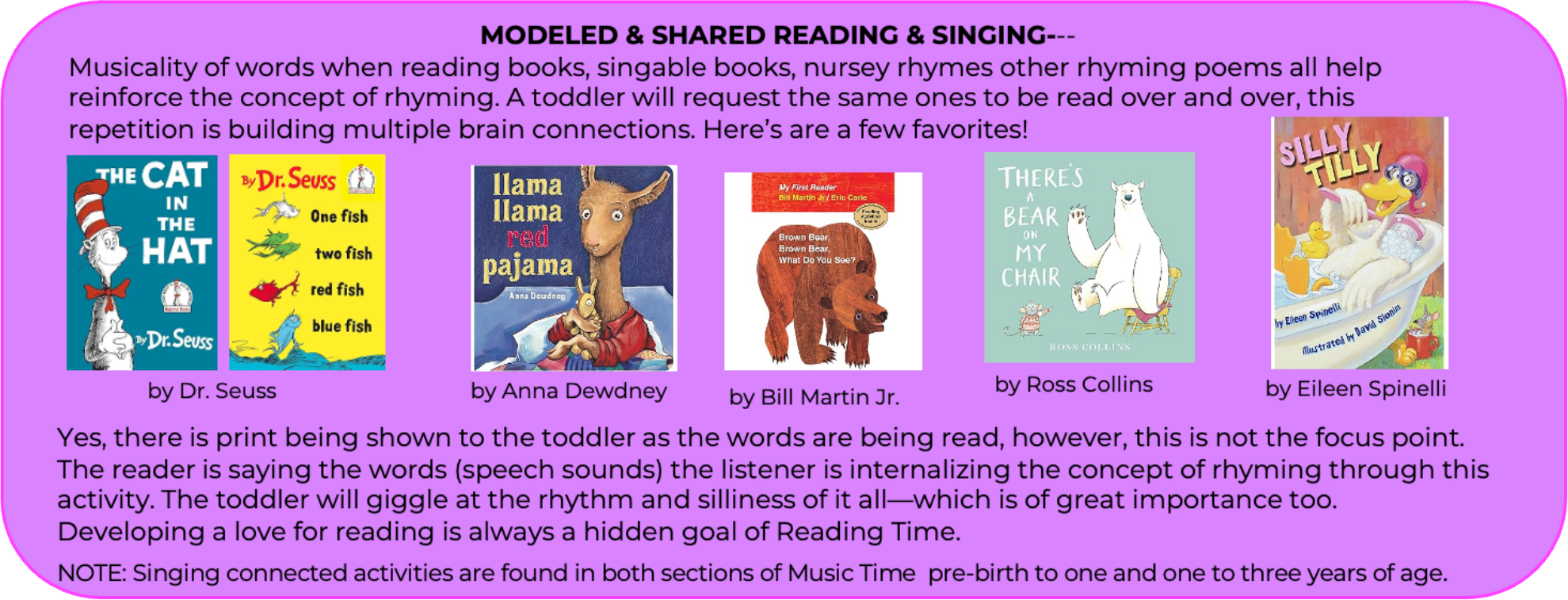
Rhyming is an easier phonological skill to use when helping a young child focus on matching ending sounds. What’s exciting is rhyming words may be either real or nonsense words, samples of a few pairings are as follows: big wig OR big lig. FIRST the concept of rhyming needs to be introduced and practiced continuously in an engaging playful manner with the young toddler. Here are some ideas that are related to word play and reading & singing. The role of the parent-teacher is to begin first by being the sole reader who models how reading works called Modeled Reading. Other readings with the toddler may be a Shared Reading experience where the parent may say the words and the toddler may join in on memorized phrases or whole sentences. Along with the back and forth discussions during reading time between the reader and the toddler, a copy cat-toddler appears and is ready for word play.
Word Play
This occurs in a spontaneous way as one goes about their rhyming day! The key is not to mention the word “rhyme” just yet. The idea is to have fun with words, keeping it short, sweet and a learning treat.
— Make up simple short poems—Happy day! Time to play! Or Happy day! Toys away!
— When getting a toddler dressed—”sock sock sock makes me think of block block block”
Be sure to repeat the same phrases daily. Don’t be surprised if soon there’s a chanting toddler joining in or even repeating it to themselves.
After lots of WORD PLAY and SHARED READING & SINGING experiences and other rhyming activities, AND if the toddler shows an understanding of the concept “rhyming”– these learning games may be used with an older child. These games are at a higher level of rhyming knowledge, and a toddler may or may not be ready for them until after the age of three. No worries, just return later to these auditory skills when the child has a deeper understanding of rhyming and could successfully complete these tasks. Remember there are many more rhyming activities for older children that assist in readying them for reading as they become pre-schoolers.

Rhyming Learning Games
–Responsive Interaction–Next steps for Rhyme Time Fun
These rhyming games are for recognizing pairs of sounds as rhyming or not, by showing a response of YES or NO using body motions. These listening activities answer the big question—Does it rhyme? YES or NO. Remember to have the child repeat the words after they’ve heard them.
Responsive body movement examples—
…..clap hands together if YES, shake hands for NO
…..thumbs up YES, thumbs down NO,
…..shake head up and down for YES, shake head side to side NO
…..jump up and down for YES, stand still for NO
Bath Time Activity –thumbs up for Yes—thumbs down for No
possible word sets: bath math, bath duck, bath path, bath bug, bath zath
In the Lap Activity–clapping hands together for Yes—shaking hands for No
word examples: dog frog, dog cat, dog log, dog floor, dog rup, dog fog, dog chair
During a re-read of a rhyming book –(a favorite) —shake head yes up and down—shake head side to side NO
select pairs in book=llama pajama, llama mama, yet fret & not rhyming=llama kisses
Alliteration
Alliteration is a listening skill targeting initial sounds (beginning sounds) in a string of two or more words or even a complete sentence. This phonological skill helps ready a child to hear the same beginning sounds over and over that are presented in a sequential manner. Hearing stories and poems with silly phrases is a delightful addition to a toddlers’ sound learning. Toddlers enjoy hearing alliteration at reading time and throughout the day. Expect delightful giggling as they hear the spoken words/sentences shared.
Alliteration is preparing toddlers’ for future reading and writing skills through sound discovery. Their role is to experience and enjoy the alliteration of repetitive sounds spoken. There are no expectations for them to reproduce alliteration examples at this age.
Syllables
Syllables are parts of a word that contain one vowel sound, with or without surrounding consonants. Word recognition skills may be introduced to an older toddler in a playful manner with physical movements of clapping, tapping or stomping. Familiar words are said or sung as the toddler produces movements to acknowledge each syllable—the rhythm of the words.

For example:
cat=one syllable (one clap)
apple= two syllables ap+ ple (two claps)
bicycle=three syllables bi + cy + cle (three claps)
caterpillar=four syllables cat+er+pil+lar (four claps)
This skill is important part of phonological awareness, mastery of syllable awareness is usually shown at an older age.
Onset & Rime
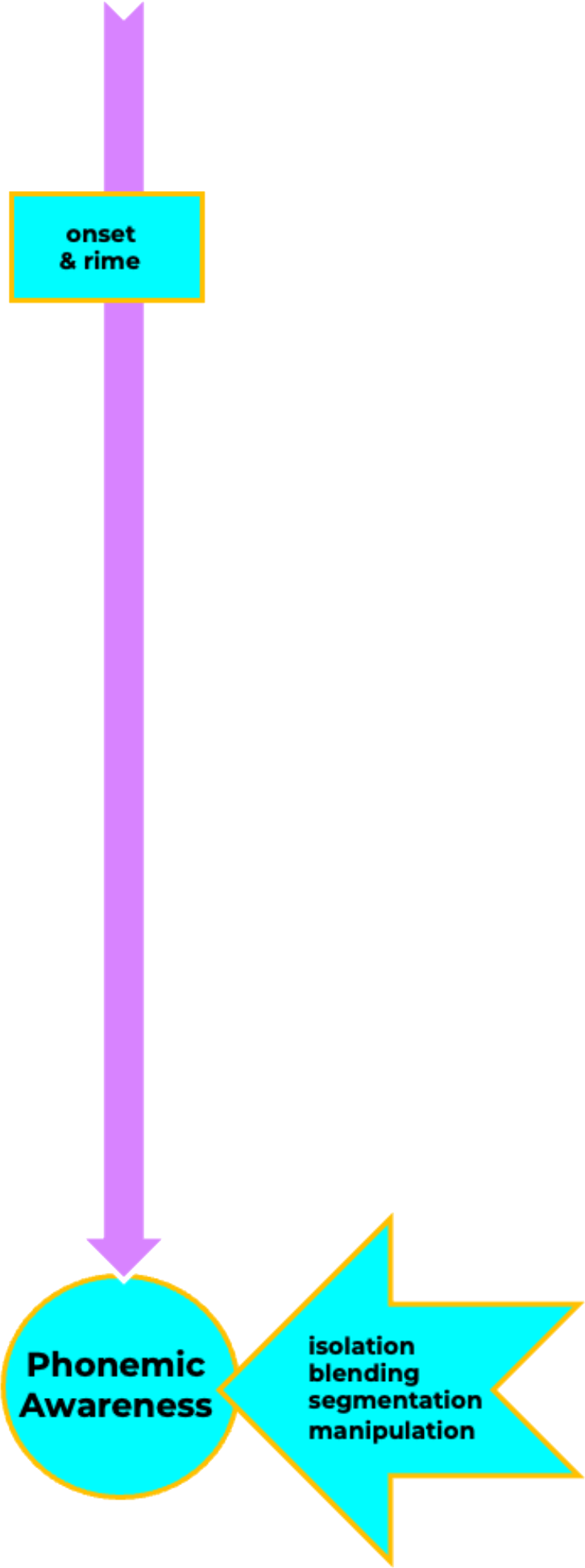
Onset & rime refers to the two parts within a word. The onset is the initial consonant or the consonant blend at the beginning of first syllable, while rime is the vowel and any consonants following it. For example:
cat c=onset at=rime
stamp st=onset amp=rime
Phonemic Awareness (Phoneme Awareness)
Phonemic awareness is the hardest skill to learn within phonological awareness. It is the ability to identify and manipulate sounds or phonemes, without PRINT. The four main aspects are as follows: isolation, blending, segmentation & manipulation. The manipulation skills are the most complex sound/word work of the four. Making sound placement changes is always an auditory processing challenge for the cognitive brain. The brains’ working memory is essential for acquiring these skills.
Phonemic awareness helps a child to know that words are made up of sound parts. This knowledge leads to understanding how word coding (phonics), spelling, writing and reading are related.

Phonemic Awareness (Phoneme Awareness)
isolation=identifying a single sound
Examples: What sound is heard first in the word cat? response= /c/ OR
What sound do you hear at the end of word bus?response= /s/
blending=combining sounds to form a word
Example: After hearing the sounds made individually — p/ / i / /g/ blend together response = pig
segmentation=breaking a word into individual sounds
Example: After hearing the word mop said at a regular speed,
response=separate sounds /m/ /o/ /p/
manipulation=adding, deleting, or substituting sounds (most complex skills)
Examples:
adding sounds ask child to add sound /f/ to /it/ response= fit
deleting sounds ask child to remove sound /b/ from word bat = response at
substituting sounds ask child to remove one sound and replace it with another
…remove the short a sound and replace it with the long a sound
say word= can response=cane
Note: Speech sounds or phonemes are bracketed by diagonal lines ( / / ) .

The oral language concepts highlighted in teal are too difficult for the majority of toddlers and will be targeted for mastery throughout pre-school, kindergarten and first grade. However, phonological awareness is part of the key components needed for emergent literacy development and age-appropriate phonological skills start in those very beginning years.
Further research regarding the idea to ONLY teach phonemic awareness orally before phonics has been studied. Many leading authorities in the field of reading are suggesting that phonemic awareness may be taught within phonics instruction—adding print (letter knowledge-graphemes) with phonemic awareness (sounds) to assist in the teaching of reading. “When a child demonstrates awareness of a phoneme (for example, being able to isolate and pronounce an initial phoneme), this can be followed by introducing the letter or combination of letters that represents that phoneme. This sequence builds an understanding of the alphabetic principle, as noted earlier. The value of incorporating graphemes when building phoneme awareness (for example, in a spelling activity) has been verified both for beginning readers in kindergarten and students who have deficits in reading at any age who have phoneme awareness weaknesses. Further, this sequential pairing facilitates the links between phonemes and letters needed for orthographic mapping of words (storing the spellings of words in memory).” as stated in an article by International Dyslexia Association.

I purposely added within this post information on skills that are too hard for toddlers. I believe it’s important to know the other elements that will be needed for a literacy learner. Additionally, always remember that a toddler moves at their own pace AND may need less or more time to acquire the important skills targeted between the age of one and three. At this age one is introducing an abundance of skills which contribute to their future literacy skills. Have fun with sounds—start early and enjoy these learning experiences!
Happy days to you,
Kylene
“Reading is important, because if you can read, you can learn anything about
everything and everything about anything.”Tommie depaola, author of children’s books

Resources & References
Bassard, Sydney, MSP,CCC-SLP,(2024), Erber’s Auditory Hierarchy, https://youtu.be/mgjK5CmPwf4?si=xNEUv9-mBIOFUHYt
CNLD Neuropsychology, How Long Should a Child’s Attention Span Be?, https://www.cnld.org/how-long-should-a-childs-attention-span-be
Cognitive Development Learning Centre, (2019), The Benefits of Nursery Rhymes for Children, https://cognitive.com.sg/the-benefits-of-nursery-rhymes-for-children
Collins, Molly F., Schickedanz, Judith A., (2024), So Much More Than The ABCs, National Association for the Education of Young Children, (NAEYC)
International Dyslexia Association, (2022), Building Phoneme Awareness: Know What Matters, https://dyslexiaida.org/building-phoneme-awareness-know-what-matters/
National Association for Child Development, Auditory Processing- What Is It?, NACD Journal, https://www.nacd.org/auditory-processing-what-is-it-hearing-vs-processing/
Noyce, Abigail L., Kwasa, Jasmine A C, Shinn-Cunningham, Barbara G.,(2022), Defining attention from an auditory perspective, National Library of Medicine, https://pmc.ncbi.nlm.nih.gov/articles/PMC9712589/
Explore More about Reading Time Investigators