


The Getting Ready stage to read comes first, sometimes called pre-reading readiness in the Emergent Stage. Toddlers are non-readers who are “wanabees”. In other words, each young toddlers’ brain has a huge want to investigate and learn how this reading thing works.
The visual below shows the key areas that contribute to their literacy transformation, changing a non-reader/writer to a pre-reader/writer. The purple oval within the teal circle contains the elements that a toddler is beginning to internalize within the process of making language connections. These oral language elements lead to their absorbing information about written print. Specific details will follow about each of the areas along with ways parents, caregivers and teachers may work together with toddlers to acquire these essential pre-literacy skills.
The whole visual circle is called EMERGENT LITERACY all the pieces are interconnected. The larger sunburst component extends out to the other three key factors shown that are combined together to create a toddlers literacy foundation.
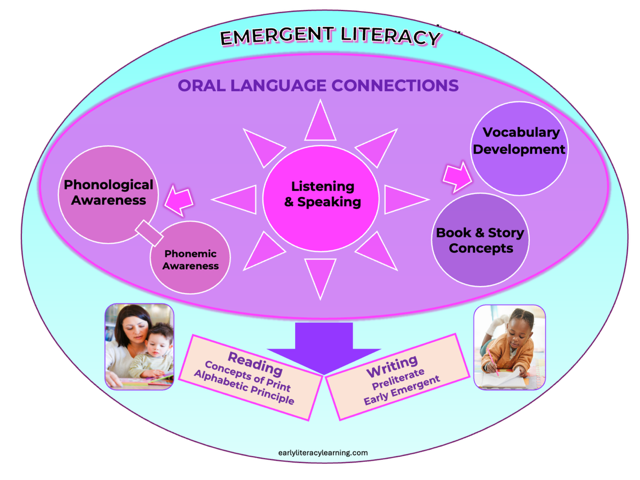
Emergent Literacy
The following four key elements shown in the visual are integrated throughout a toddler’s first years of language learning. The groundwork is being built for acquiring reading and writing skills through the use of listening & speaking, phonological awareness, vocabulary development, book & story concepts.

Listening & Speaking
Listening is the receptive part of language while speaking is the expressive part, both operate in conjunction with each other. They impact all aspects of a toddlers’ oral language abilities.
A toddler has gained many skills enabling them to communicate verbally what they are learning about their world. Their oral language production is increasing at a fast rate. Listening to words and interpretating what they mean is becoming less of a struggle for the toddler. Speaking is shifting from single words to short phrases and later longer more complete sentences do appear. Also, included in their language exchanges are non-verbal communications, for example: gestures, facial expressions and body language.
Listening and speaking comprehension gained through daily conversations, experiences and interactions are essential for a toddlers’ success with their early language learning. Together they are the foundational skills for communicating and the development of literacy skills.
Phonological awareness, vocabulary development and book/story concepts are dependent on their connectiveness to language. Introducing and assisting toddlers in acquiring them leads to future successes in reading and writing.
Note: More detailed information may be found in the section called Language to Literacy
and Blog posts within this website.

Phonological Awareness
Phonological awareness is the ability to recognize and manipulate sounds in a spoken language, without PRINT. These are all auditory processing skills related to language development. It’s usually broken down into four main parts.
These skills are essential for “tuning the ear” to sounds, before starting the intensive phonics work of letter-print, or sound-phoneme correspondence.
Phonemic Awareness (a harder subskill of Phonological Awareness)
Phonemic awareness is the ability to identify and manipulate sounds or phonemes, without PRINT being involved at all. This is an advanced auditory processing skill and is broken down into four sub skills:
Phonemic awareness is the more difficult skill of phonological awareness. Researchers have discovered that, “It is essential for learning to read in an alphabetic writing system and is a strong predictor of early reading success. In other words, if a child can complete phonemic awareness tasks, they are more likely to be a good reader.” as stated by the National Center on Improving Literacy.

These oral language concepts tend to be more difficult for toddlers and will be targeted throughout pre-school, kindergarten and first grade.

Vocabulary Development
Increasing the number of vocabulary words that a toddler understands, and uses is critical for their future literacy success. An expansive word bank will later assist them with their reading comprehension, speaking skills, and written communications.
Toddlers expand their vocabulary in two ways, being taught new words and absorbing new words naturally heard within their environment. Toddlers do repeat words heard without knowing their meaning, therefore, new words need to be spoken by the toddler in a contextual manner to show an understanding of their meaning. Words may be acquired through supportive actions presented to a toddler by the use of hand motions-pointing or body responses.
Background knowledge
Prior knowledge, experiences, and information that is learned and stored in a child’s memory about themselves, objects, people and their surroundings strongly influences their vocabulary development.

Book & Story Concepts
Book Concepts—Modeled & Shared Reading Experiences
Once a toddler has handled books consistently during reading time, they will begin to learn how a book works: front/back, right side up and page turning. Later, a toddler begins to understand that text goes from left to right, top to bottom following multiple book shared reading interactions. They start to learn that words contain meaning upon hearing and viewing what’s being read to them. Also, they begin to notice that the reader says words expressively leading them to realize the text gives clues on how it’s read aloud. (Sometimes this concept is included with print awareness, however, these language connections are beginning to emerge now during shared reading.)
Story Concepts—Modeled & Shared Reading & Storytelling Experiences
Story concepts may be learned through the reading of books or the retelling of personal life memories or the creation of imaginative stories. The toddler is starting to be aware of the following ideas through numerous exchanges with stories:

Gaining these skills on the road to reading may seem to be over-whelming and challenging for all involved. This is the beginning stage that’s transpiring for the young toddler over these early years. Be sure to make it a fun and magical learning connection. Start slow and select a few items to work together on. Many of these items listed continue to be attained during ages three to five.
It’s exciting to realize that multiple oral language elements may be addressed during one shared reading experience, for example:

…unknown words are introduced within the story—vocabulary development discussion
…rhyming words are present throughout the book–phonological awareness interaction
…turning the pages together—book handling practice
All of this occurs when snuggled up close together during reading time. Jointly an enjoyable relationship is being created while the words flow during a read aloud or shared reading. The colorful pictures/photos that are viewed and or discussed contribute to their learning experience. What a fantastic way to develop those oral language connections!

Parts One, Two and Three of Reading Time posts have provided essential details—”the back story”—for beginning literacy learning. The Blog posts to follow will focus on what one can do to help their toddler learn these skills. Just remember attaining reading is a complicated process, consisting of many interconnecting pieces. Working and playing together throughout the day with language is what it’s all about.
Happy days to you,
Kylene
“We see how early childhood experiences are so important to lifelong outcomes, how the early environment literally becomes embedded in the brain and changes its architecture.”
Andrew S. Garner, Pediatrician

Resources & References
Bretz, Christina ,Dr., (2025), Emergent writing: 3 ways to plant seeds for lifelong literacy , eSchool News, https://www.eschoolnews.com/innovative-teaching/2025/08/04/emergent-writing-3-ways-to-plant-seeds-for-lifelong-literacy/#
Collins, Molly F., Schickedanz, Judith A., (2024), So Much More Than The ABCs, National Association for the Education of Young Children, (NAEYC)
Hannon, Claudina, Reinforcing Language Skills for Our Youngest Learners, NAEYC, National Association for Education of Young Children, https://www.naeyc.org/our-work/families/reinforcing-language-skills
National Center on Improving Literacy, Phonemic Awareness: What It Is and Why Is It Important?, https://www.improvingliteracy.org/resource/phonemic-awareness-what-is-it-and-why-is-it-important
Reading Rockets, Stages of Writing, https://www.readingrockets.org/classroom/looking-writing/stages-writing
Zero to Three, (2016), Storytelling in the First Three Years, https://www.zerotothree.org/resource/storytelling-in-the-first-three-years/#:
Explore More about Reading Time Investigators