


Word knowledge increases during multiple conversations and experiences throughout the day. Previously essential information regarding vocabulary development was shared in other parts of this website. Let’s take a closer look at the learning connections that occur during the reading of books. Engagement and the exchanging of ideas at reading time does lay the foundation for one’s toddler on their road to reading.
A critical element for understanding and making connections for a toddler is background knowledge or sometimes called prior knowledge—hearing and repeating words doesn’t equal knowing the meaning of a new word. Toddlers require clear examples and multiple exposures in order to comprehend a words meaning. Expanding a toddlers vocabulary development does happen during their daily life experiences, and reading time leads the way in building their background knowledge of words & concepts.
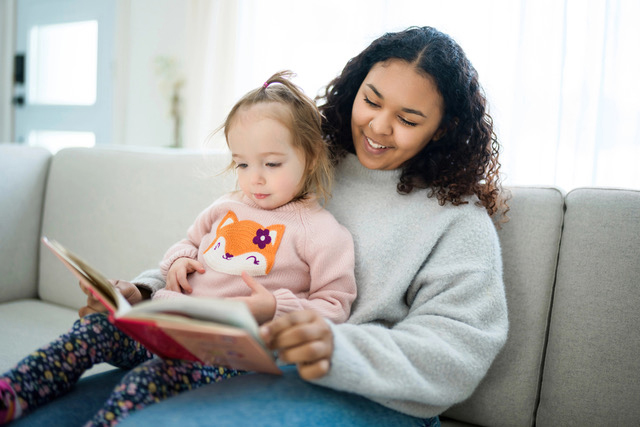
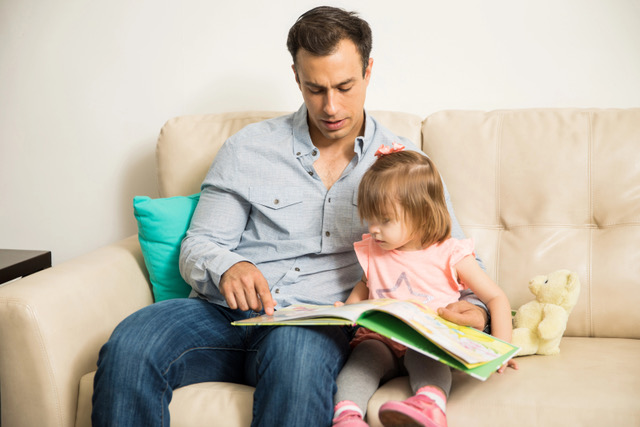
Toddlers love this special time of having someone all to themselves, an amazing intertwinement occurs. As bodies are cuddled close together viewing the pages of a book and words are being vocalized by the reader, a magical bubble appears transforming the listener and the reader into becoming one with the book. Concurrently the words read to a young investigator may open up the doors to a fantasy journey while immersed in a fictional story or a learning explosion occurs as real-world details are shared in the reading of a non-fiction book. Here’s a short but accurate quote that sums up the importance of reading to a child shared by Emillie Buchwald, an author—
”Children are made readers on the laps of their parents.”
Not only is literacy learning taking place during this nurturing “lap reading” experience, but other important related benefits are occurring during the reading time. The young toddler brain is busy at work!
Reading daily to a toddler on a regular basis is not a new idea—so true! However, there are strategies one may use during this time that will strengthen the interconnections of the four main developmental domains: language/communication, cognitive, social/emotional, and physical aspects.
Lanuage/Communication
*expands oral vocabulary—understands meaning of new words
*enhances verbal communication–discussions of vocabulary words & content concepts
*utilizes background knowledge–supports and expands prior knowledge of life experiences
Cognitive
*enlarges mental abilities –improves memory & attention span
*practices beginning comprehension skills: prediction & cause/effect & problem solving
*strengthens auditory processing–increases listening capabilities & focus on speech sounds
Social/Emotional
*fosters emotional growth–develops empathy & shared feelings
*creates an intimate connection–forms a deepening bond and closeness
*awareness of voice & facial expressions –tone & emotions heard/seen
Physical
*strengthens fine motor skills—practices book handling/page turning
*increases visual awareness—recognizes visuals are meaningful to what’s read
*assists to develop eye-hand coordination—book handling & locating pictures & pulling tabs or lifting flaps
Dr. Phillips, PsyD, a neuropsychologist at the Child Mind Institute put it this way, “The physical contact that you get from being held by your parent while you’re reading actually helps to engage neurons in the brain, which make kids more receptive to the language and the cognitive stimulation that they’re getting from that.”
Let’s dive deeper into creating a knowing of how to weave together interactions that produce these multiple benefits or as the saying goes “get more bounce to the ounce”!
During the first months of their toddlerhood some toddlers may still have a want to continue to be in the “taste phase” of book learning. Soon this want will disappear as it will be replaced by the “gentle touching phase” –after a lot of patience by reader and plenty of practice by the toddler–!! Using a tender tone when modeling how one treats a book helps this learning process. Try saying something like the following “Remember honey, books are for reading not eating.” while quickly redirecting their attention to a colorful picture on a page in the book.
Previously favorite books may have been either cloth or board books which are specifically designed for the mouth testing investigators. These type of books provide babies an introduction and safe way to engage with books—sensory play at its best—plot twists not necessarily so. Around 18 months toddlers have a deeper understanding and success with handling the paper pages differently. Their fine-motor skills are getting better. Yes, accidents still do happen, and a page may get torn – grab that handy tape and make it all better. Just as if the tape was a band aid used to heal an owie!
It’s natural for a baby to investigate this exciting thing—the book– that is being shared with them. Lovingly help toddlers to learn “how a book works”. Front/back, right-side up, and importance of pictures to the text in a book. Each day builds on another until “presto” book awareness and handling is mastered (well almost).
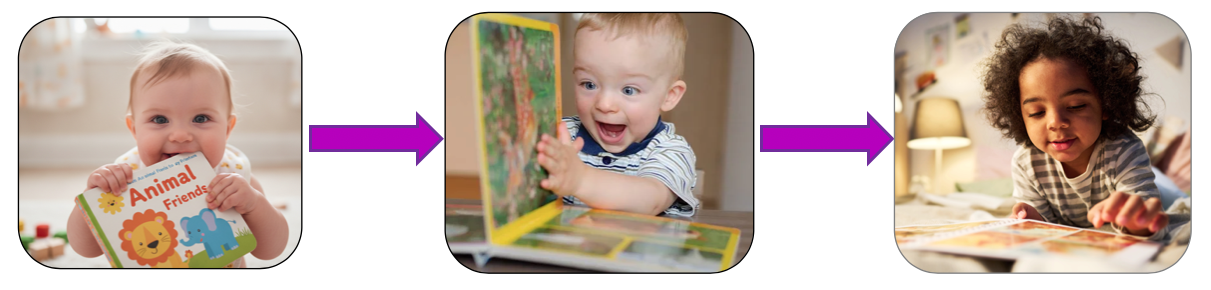
The two-year toddler age span of 12-36 months is challenging and memorable. It’s important to consider that not all toddlers grow and learn at the same rate. Each toddler will acquire beginning reading readiness skills at their own pace and timeline. Helping a toddler to acquire various reading skills does depend on their attention span, listening skills and want to investigate books. Just know success is on its way!
NOTE: At this time the discussion will focus on using books—not e books, or kindle-or multi-media book presentations & screen time. These will be addressed at a later time.

Read Aloud Interactions
It’s exciting to observe the interactions between a toddler, the reader, and the book. These three pieces work together in creating a positive read a loud experience, similar to the small interior parts of a watch which are called jewels. The jewels keep the gears moving, contributing to its goal of keeping time. Love that concept of “jewels” creating movement together. Let’s take a closer look at how the three main “jewels” move together in reading time. The visual shows the interactions that occur during read alouds – the three jewels at work.
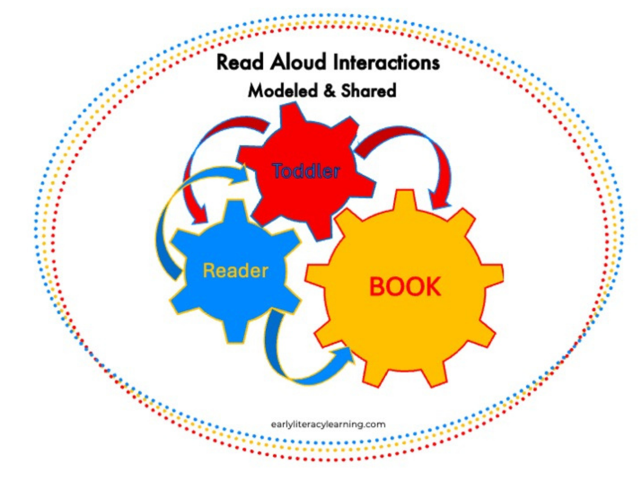
Modeled and Shared Reading
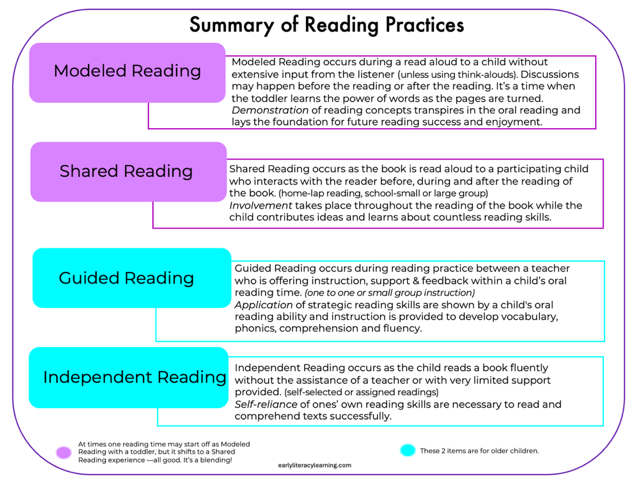
There are four main components that may be used when teaching reading: Modeled, Shared, Guided & Independent. The first two are ones to use during read alouds with toddlers. Sometimes the four have been condensed to mean the following: Modeled=read to a child, Shared=read with a child and Guided plus Independent=read by the child. ( A more detailed chart of the four reading practices may be found at the end of this post.)
Modeled Reading—the reader is a MODEL to be watched/heard during the reading of each book read to the toddler. The reader acts as if they are on a runway walking down a platform before a crowd showing off their modeling skills. In this instance the reader is presenting a book to a crowd of one.
- Before-The reader leads a short discussion with the toddler: talking together about the cover & title, discussing ideas about what the book could be about, plus reader introduces any new vocabulary words.
- During-The reader reads with expression—modeling how a good reader reads and that the words/print on a page have meaning. The toddler is the listener/watcher, absorbing the reading process in action as the words read are heard. Learning is taking place each and every moment.
- After-The reader and toddler continue their interactions by talking about the book.
“What was the book about? Or What was their favorite part? Who was this story mainly about? etc.
Key to remember that in a Modeled read aloud the toddler has the role of listener and watcher during the reading of the selected book.
Shared Reading—the reader SHARES with the toddler the complete book reading experience, by including the toddler to actively participate in all three parts: before, during and after.
- Before-The reader leads a short discussion with the toddler: talking together about the cover & title, discussing ideas about what could this book be about, plus reader introduces any new vocabulary words
- During–The reader and toddler have back and forth conversations. The reader invites the toddler to contribute during the reading by encouraging the toddler to participate in book/story sessions by answering their questions or asking questions.
*making predictions— What do you think will happen next?—(throughout the book stop-ask question before turning page)
*discussing vocabulary – Reader says ”Love that word “whimpers”. I’m going to whimper now—(reader whimpers) your turn to whimper.” Toddler takes a try at whimpering. “Great sound. Yes, whimpering is a sad sound.”
*key aspects & concepts—emotions –- ”How do you think the lost dog felt?”
cause & effect, –”Before pulling the tab – ask-Wonder what will happen to the frog?”
- During-The toddler may want to do the book dance of “follow the lead of the toddler” –a go with the flow-discussing their interests and connections throughout the read OR the mood of the toddler may lead to –skipping pages, picture pointing, sharing their own interpretation of what’s happening on a page, repeating key phrases only but over and over!
- After-The reader and toddler continue their interactions through their discussions about the book.
setting–Where do you think this took place?
comparison—Did anything like this happen to you?
view of story—What did you like or dislike bout this book? Why? or Why not?
NOTE: Remember to share your views and answers first. This especially helps as the toddler is trying to understand how one might respond to a certain questions or requests. Also, if they have no reply -say “Let’s look together to find the answer.” or “We can come back to this later.“ Always praise their tries and shares—they are beginners who do want to participate and may not know how to do that just yet. The reader should accept the toddlers answer or share “Yes, I understand how that connects to what happened to you”. “Or “That’s really interesting.”
Modeled Reading Examples (toddler listens during reading)
The reader and toddler start reading time by taking a look together at the book cover, make predictions about what the book is going to be about. Keep it short and sweet in the beginning. Discussions will become longer with the age of toddler. Pointing is an acceptable way to show their interest. (This may be the first reading of the book or a revisit.)
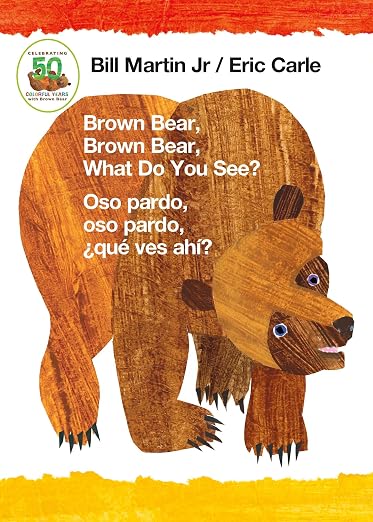
**Brown Bear, Brown Bear, What Do You See? By Bill Martin Jr. A Fiction book – This book uses a repeated chant.
Before: After looking at the cover together reader asks “What do you think this story is about? If unsure the reader may share “It’s a bear.” Reader looks at bear and describes the animal , “Yes, this is a bear with fur all over its body and claws on its feet. What animals might the bear meet in this story? Accept all responses and say, “Yes, maybe the bear might meet those animals—we’ll find out soon. Let’s hear the story now” –If this book has been read before—reader may ask “What animals do you remember that the bear met in this book?
During: ”Time for me to read the book to you now.” Reader does all the reading.
After: Reader guides a discussion of the book (may ask questions or share personal connections) Reader ”I once saw a bear at the zoo. It was black. It was bigger than I imagined.” OR “What animals did you like in this story? Why?” (A young toddler may just point to the one they liked which is giving an answer—Reader may respond, “Yes, I see that you like the yellow duck.”(The back pages have all animals in book to pick from.) If toddler responds duck, reader restates response in a sentence- “Oh, you liked the yellow duck the best!” The toddler does not have to state complete sentence with color—that will come with multiple reads. Reader shares—”I liked the colorful red bird.”
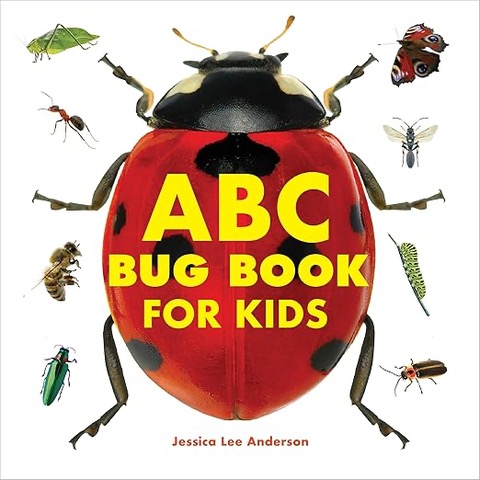
**ABC Bug Book for Kids by Jessica Lee Anderson A Non-fiction book –-This book is an ABC book and uses photos of many bugs. It’s an easy way to introduce the alphabet since the bug information is read in ABC order. However, a toddler is just learning about ABC letters in print and in the beginning the reading should be focused on the content of the book and not letter recognition.
Before: The reader and toddler look at the book cover and discuss it. ”Yes, that is a big ladybug. It has spots and lots of legs. How many legs does it have? Touch and count together-and say six. This book has lots of information about many kinds of bugs.” Reader may ask–What bugs do you hope to learn about? Hint-point out the other smaller bugs on the cover. Reader-”I want to learn about the dragonfly and grasshopper.” Toddler may point to one of those. If read before—may ask “Can you name a bug I read about the last time? May or may not recall a bug-toddler could find it on cover or the page showing photo of a bug they liked.
During: Reader reads information about the bugs OR reads only about first eight pages and saves the rest. A toddler could flip through pages and select which bugs they wish to learn about or hear about again.
After: Reader ”What was your favorite or least favorite bug that I read about today? Why?” (may point to photo as answer) Sometimes share your favorite or least favorite bug with them after their response. Tell them why you selected it too.
NOTE: The category BUGS includes insects and spiders because they do not have the same characteristics. One example: the number of legs each bug has on their body– insects=6 legs spiders=8 legs
Shared Reading Examples (Reader and toddler interact during reading)
Before reading the reader shows the title of book and shares the name of the author. The book may be a new first read or has been previously read. (Some have been reread over and over many times LOL.) Each reading may be used to guide their understanding of important concepts presented in the book, conversations may address vocabulary, comprehension concepts and/or print awareness.
..Start with a book talk—think of this as a commercial if it’s an unknown book— enticement galore –(a salesman making a sale to a welcoming buyer).
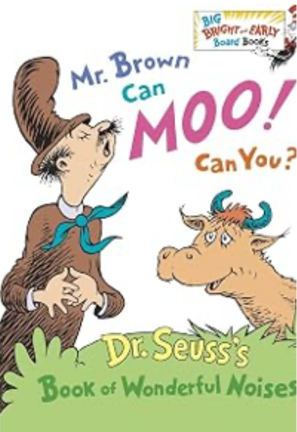
**Mr. Brown Can Moo! Can You? by Dr. Seuss—This book is fun and engaging!
Before: “Have I just found an exciting book to read today! It’s called Mr. Brown Can Moo! Can You? Let’s try that sound together–Moo! Moo! I wonder what other noises are made in the story? (Accept all responses by toddler – meow, cluck, honk –(all OK– learning to make predictions) and acknowledge what has been shared.)
During: “Let’s find out now! As I read say the noises with me.” This story moves fast with plenty of repetition and rhyming. Joining in together on the sounds expressed throughout the book makes it an enjoyable treat.
After: Reader may ask toddler their favorite part—if they’re unsure about giving a response— look through pages together once again—Younger toddler may just point or repeat sounds, while an older toddler may reply– “I pick train — Choo Choo Choo!”
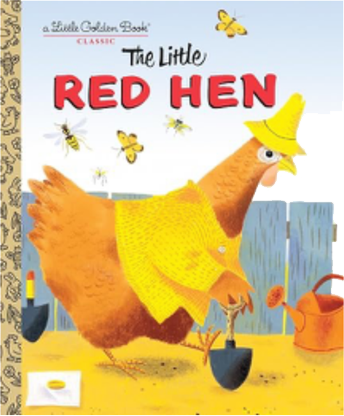
**The Little Red Hen, A Little Golden Book—(key characters of this story have simple responses to questions asked by the Little Red)
Before: ”Here’s a fun story for us to read today. Let’s look at the cover before we begin. I wonder –Who do you think this may be about? (says chicken or points to it) Yes, I see a chicken. In our story she is called a hen. ( Reader could share –a hen is a female chicken who lays eggs
and a rooster is the male who crows early in the morning.) Reader may explain a new vocabulary word–character—a person or animal the author/writer is writing their story about. May ask next—Who do you think is the main character in this story?” “Where is she?” Accept answers-” Let’s read to find out.’
During: Begin reading the story—toddler may want to repeat the sayings of other animals as well as the hen at this time. Super! When you do another read—reader says the Little Red Hen part and toddler says the three animal parts — Toddler says, “Not I!” until the end-a change of heart occurs, and all say ”I will!
After: Talk about the story and discuss—”What was the hen doing? Did the other animals help? Depending on age of toddler—One could talk about things they help out with and how the reader appreciates it. Reader could ask, “How do you like to help at home?” (If unsure—reader ”Picking up your toys is always big help.”
READING Time: Making Connections
Information regarding interactions & conversations—
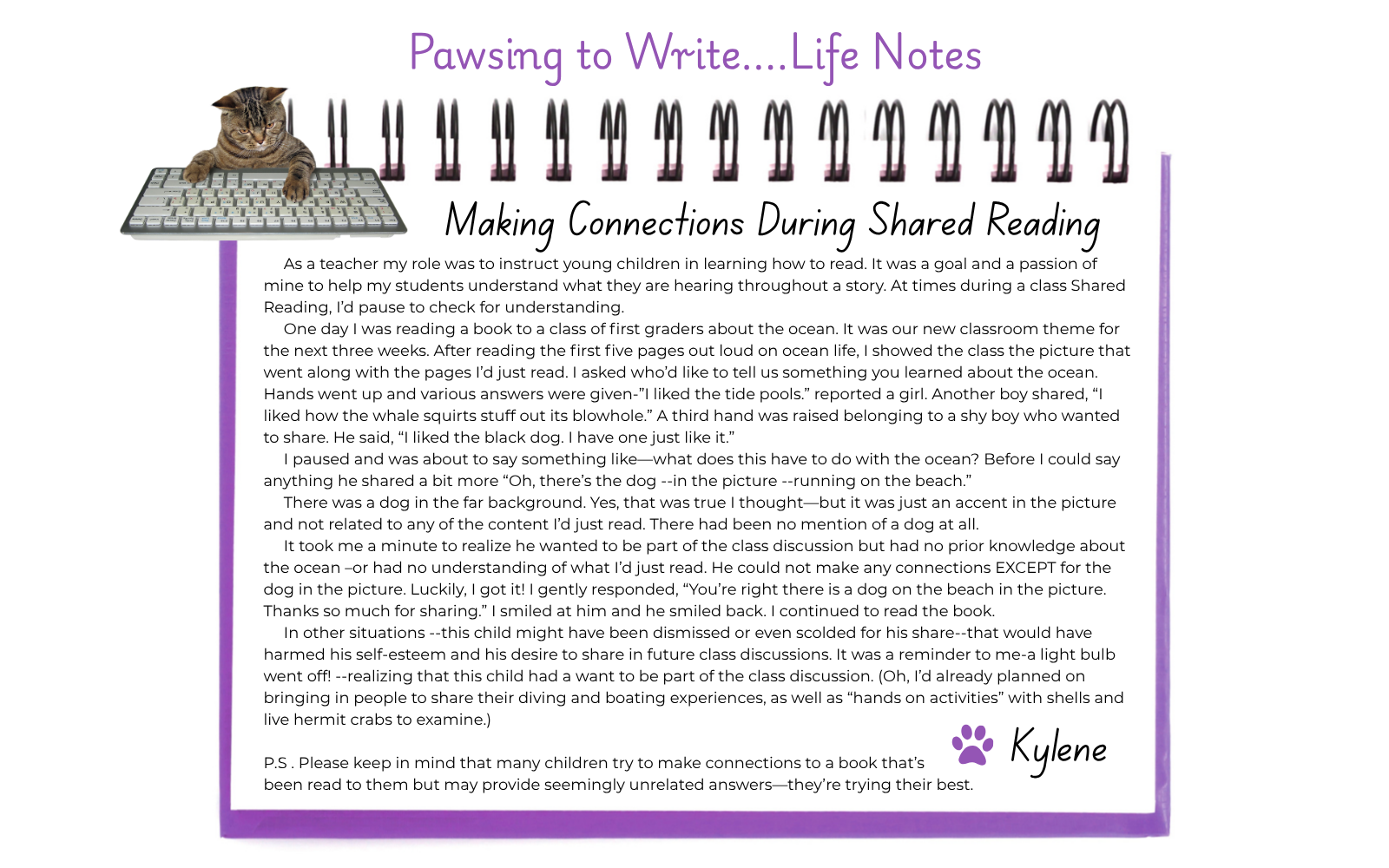
Making Connections: Authors E. Keen & S. Zimmerman wrote Mosaic of Thought which focuses on strategies good readers use to understand text and make connections. Making connections to text heard or later books read by themself is important for reading success. Yes, this book was written with older children in mind, however, many of their strategies do assist younger children in making connections to what they are hearing or reading. Let’s “tip toe” into the first and second “text connections” that may be used with the three jewels– (reader–-toddler–- book) during read aloud interactions.
The word “text“ refers to any written print/words found on paper, multimedia – digital devices, books etc. It’s separate from illustrations or photos.
***Text to Self –toddler makes connections to personal life experiences—(older children would focus on their own life connections to text they’ve just read or heard)
An example with a toddler: After a read aloud of Who’s That Cat? by Steph Clarkson, a very funny book about cats! The reader might ask the toddler “Have you ever seen a cat doing something silly?” Reader goes first, “ It reminds me of when I saw the neighbors cat rolling in a pile of leaves.” If the toddler has nothing to say –all Ok—try again another day. However, if their response is about a squirrel doing something funny – that works! The toddler is explaining a connection to the story but using a different animal.” Praise this communication. The brain at work!
***Text to Text –- toddler makes connections between a previous book read to them and the current book just heard- (older children will focus on connections to text they’ve previously read or heard, and the text currently reading or just heard)
An example with a toddler: After a read aloud of The Tale of Peter Rabbit by Beatrix Potter. —Reader says ”Wow, this book reminds me of that other book we read a few days ago, Who’s That Cat? In the new book Peter Rabbit hopped into the garden where he does unwanted behaviors. In Who’s That Cat? the cat scratches the chair and isn’t supposed to do that. Can you think of other ways these stories might be alike?” The toddler may add comments or not. The reader is offering up connections, giving examples of what one could think about during a read aloud.
***Text to World – connections to the larger world-This specific comprehension concept is too hard for a toddler. Older children begin to create a broader view and understanding of the real world. This type of connection is not about personal experiences. For example: with an older child, after reading a news release on a new scientific discovery: A question to ask–How might this discovery impact the world?
READING Time: Bits & Pieces
Other information regarding interactions & converstations—
Follow Leader?
Some days during a read aloud it will be a “follow the lead of the toddler day”. —They might pick the book and want a brief read—meaning the pages will be flipped by the toddler ever so quickly or even choosing to skip some pages altogether. Play their game—read some pages or even shorten what’s been written. The book investigators are at work and play—learning experiences are occurring with every Reading Time.
Skip About?
Some days during a read aloud if the reader tries skipping some pages altogether or shortening what’s written on a specific page—this may not work. The toddler knows what should be read and will remind the reader—to read every word in book! Memorizing has kicked in. The cognitive toddler brain is saying that it needs predictability in their learning.
Read It Again?
Some days may start off with the toddler selecting the same book just read on a previous day. Now the reader/toddler has moved into the “ Read it again zone.” Maybe it’s even the same day the reader will hear, “Read again!”
Over and over a call for the repetition of their favorite book will be expressed. The toddler brain is soaking up vocabulary, making comprehension connections and so much more by the repeat book presentation! Really, it’s a good thing for their developmental growth—the reader accepts it comes with the territory of read alouds. Buckle up, smile and repeat–it again!
Family Zooming and FaceTime
Chatting to family & friends on devices that include the toddler – can be a stimulating activity. These face-to-face interactions on one’s devices offer social/emotional connections and support early language learning. Being included at a family chat does benefit a toddler immensely.
Print books or e books for Toddlers??

This is not an either or question since both offer varying experiences with print. It’s all about the quality and quantity. Making meaningful connections and interactions during reading an e book is using the three jewels—reader -toddler –book/device. The American Academy of Science in a study concluded“Parents and toddlers verbalized less with electronic books, and collaboration was lower.” Just remember to keep up those discussions when using e books at Reading Time. More scientific studies are currently analyzing this specific question.

Screen time for Toddlers??
(other than e books) Screen time is an important subject that is on every parents’ mind. Digital devices are a part of our society, but how do they fit into a toddlers’ developmental growth?
American Academy of Pediatrics advises keeping children away from screens until they’re 18 months old and limiting digital media use for 2- to 5-year-olds to one hour per day. Currently an abundance of information regarding this topic is available via social media. Plus, additional studies are being done to understand how a toddlers’ brain is impacted by screen usage.
Can Screen Time Be Educational for Toddlers? Presented by PhD David Andersonis an excellent video to view regarding this subject. (link found in Resources & References)
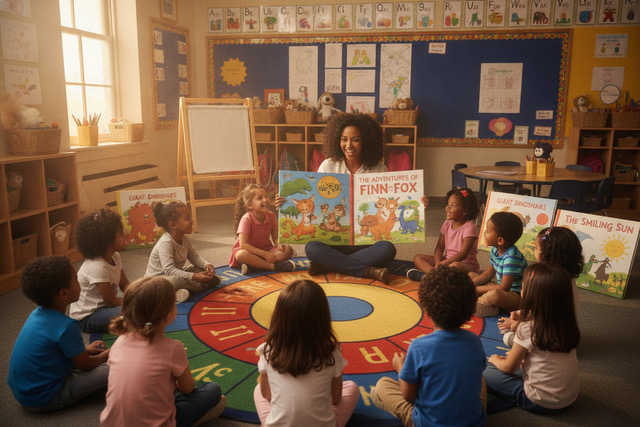
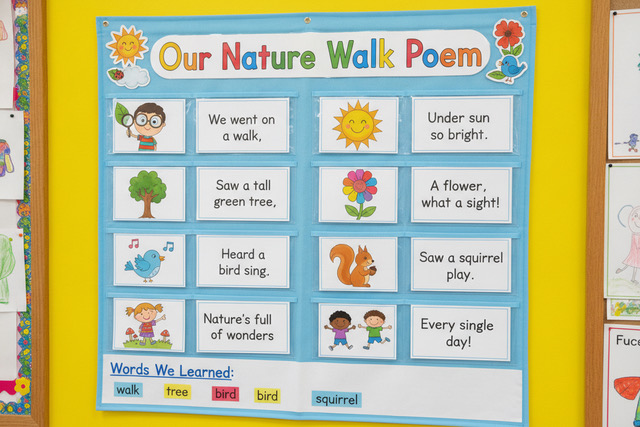
How does Modeled and Shared reading work in a classroom? A classroom teacher doesn’t have the time to read individually to each child, therefore, it occurs both in small and whole class groupings. Teachers use large oversized books and charts containing poems during reading instruction. Using these materials and the closeness of the group helps to replicate the home benefits of the lap reading experience. It allows the students to view enlarged print and pictures in this format while participating in a Modeled or Shared Reading experience. The teacher selects books that lend themselves to specific instructional concepts; phonemic awareness, phonics, vocabulary and comprehension skills. Along with other related literacy skills needed for preschool-first grade, such as, phonological awareness, language concepts, concepts of print, and alphabetic knowledge. At other times during the day there are whole class book reads, where the teacher reads regular sized books to and/or with the class listening. It’s an additional time to work on reading skills or enjoy a literature book.
Also, there are other opportunities for children to become engaged with literacy during the day: center time exploration and independent reading time. Guided Reading occurs in small reading groups where the teacher assists a small number of children in gaining specific targeted reading skills. All these practices work together to help the child become a successful reader.

There are so many more pieces of early literacy learning. The next post will talk about concepts of print & alphabetic principle. Lots more fun to be had by all!
Happy days to you,
Kylene
“Books and doors are the same thing. You open them, and you go through into another world.”
Jeanette Winterson, author

Resources & References
Anderson, David PhD, (2026), Can Screen Time Be Educational for Toddlers? Child Mind Institute, https://youtu.be/dAcg-bY0EZQ?si=jy3kJNFCnYn5QJqc
Boston Children’s Digital Wellness Lab, (2022), Ask the Experts: E-books vs. Print Books for Toddlers, https://digitalwellnesslab.org/articles/e-books-vs-print-books-for-toddlers/
Dubinski, Allison, LCSW, (2025),Why Should You Read to Your Child?, Child Mind Institute, https://youtu.be/ktpOGQfZOU8?si=iq8KB-dVxLpIOT61
Headstart, Background Knowledge, NCECDTL- National Center Early Childhood Development Teach and Learning, https://headstart.gov/sites/default/files/pdf/no-search/dtl-pla-background-knowledge.pdf
Keen, Elin Oliver, Zimmermann, Susan, (1997 & 2007 Editions), Mosaic of Thought, Heinemann
Learned Science, (2026), The Adorable Science of What Happens When Parents Read To Babies, https://youtube.com/shorts/QpMFYXvqDLY?si=IofPXgpBoty6x3B9
The Montessori Room, (2026), Why Does my Toddler Want to Read the Same Book Over and Over Again, Lannaman, Katie, Early Childhood Educator, https://youtu.be/s8zotA3cCjE?si=NtfymiZVsElkHfjD
Munzer, Tiffany G., Miller, Alison L., Weeks, Heidi M., Kaciroti, Niko Radesky, Jenny, (2019), Differences in Parent-Toddler Interactions With Electronic Versus Print Books, National Library of Medicine, https://pmc.ncbi.nlm.nih.gov/articles/PMC6564071/
NAEYC, 8 Creative Ideas to Help Your Child Learn New Words, Bowman, Vicky, https://www.naeyc.org/our-work/families/literacy/learn-new-words
Raising Children, (2023), Reading with toddlers:18 months -3years, Australian Parenting Website, https://raisingchildren.net.au/toddlers/play-learning/literacy-reading-stories/reading-with-toddlers
Zero to Three, (20216), How to Introduce Toddlers and Babies to Books, https://www.zerotothree.org/resource/how-to-introduce-toddlers-and-babies-to-books/
Explore More about Reading Time Investigators