


Babies have “no-concept of print”. They have many wants but understanding print is not on their “it” list. Their main “it factors” or basic needs are as follows: food—feed me, love—hold & kiss me, interaction—talk & sing & read & play with me, cleanliness—change & wash me, sleep—rest me, safety–protect me.
As a baby’s brain and body grows their list of needs and wants increases. Their personal world is expanding from learning about themselves and their family to what’s around them.
One mystery that is puzzling to them is print, it’s appearing everywhere. It’s like a veil has now been lifted and reveals a new world to be investigated. They are becoming interested in print, those written letters found within and outside their home. The young investigator is curious about those red signs which have four marks– S T O P, or big letters or logos seen on buildings during outings in their car. Home offers more up-close print examples to examine—letter magnets on a refrigerator, words on food boxes, letters on blocks and words read to them at reading time. A toddlers’ brain is beginning to be attentive to an idea called concepts of print, it’s an important part of their emergent literacy learning.
Let’s take a closer look at the different aspects of concepts of print, sometimes called print concepts. To be interested in print opens up the door to learning what print is about and leads to deeper understanding that print carries meaning.
Toddlers do become curious about letters and words in their environment. They begin to point to a big sign on a building where food is purchased “What’s that?”—”FOOD MART “the driver replies. STOP signs are a help to support beginning awareness to environmental print. Mainly because they are colorful, always shaped the same and are found everywhere. Whether one is taking a short shopping trip or a long drive stop signs are ever present. Let’s take a closer look at the process of how the toddler brain becomes aware, engages and learns about environmental print outside the home—using the STOP sign. (T=toddler action D=Driver action)
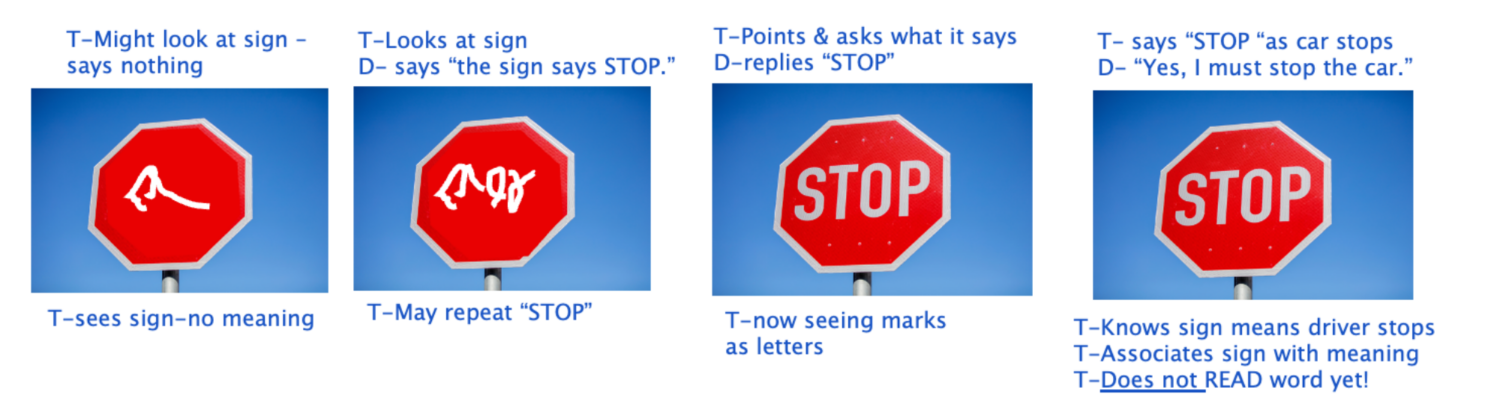
Stages of Knowing: A “STOP” sign is made of letters S-T-O-P which creates the word STOP and means a car must stop. What a very young toddler first sees are visual cues, a bunch of squiggly marks that are meaningless. They see a red shaped sign (might know color red) and learn from many experiences in a car that when one of these things shows up the car will stop. If one were to mix up the letters –PTOS –and put them on a similar shaped stop sign the toddler would still say “STOP” or “must stop”. Learning that every word has a permanent order to its letter placement occurs later, the actual reading of the signage words will develop later.
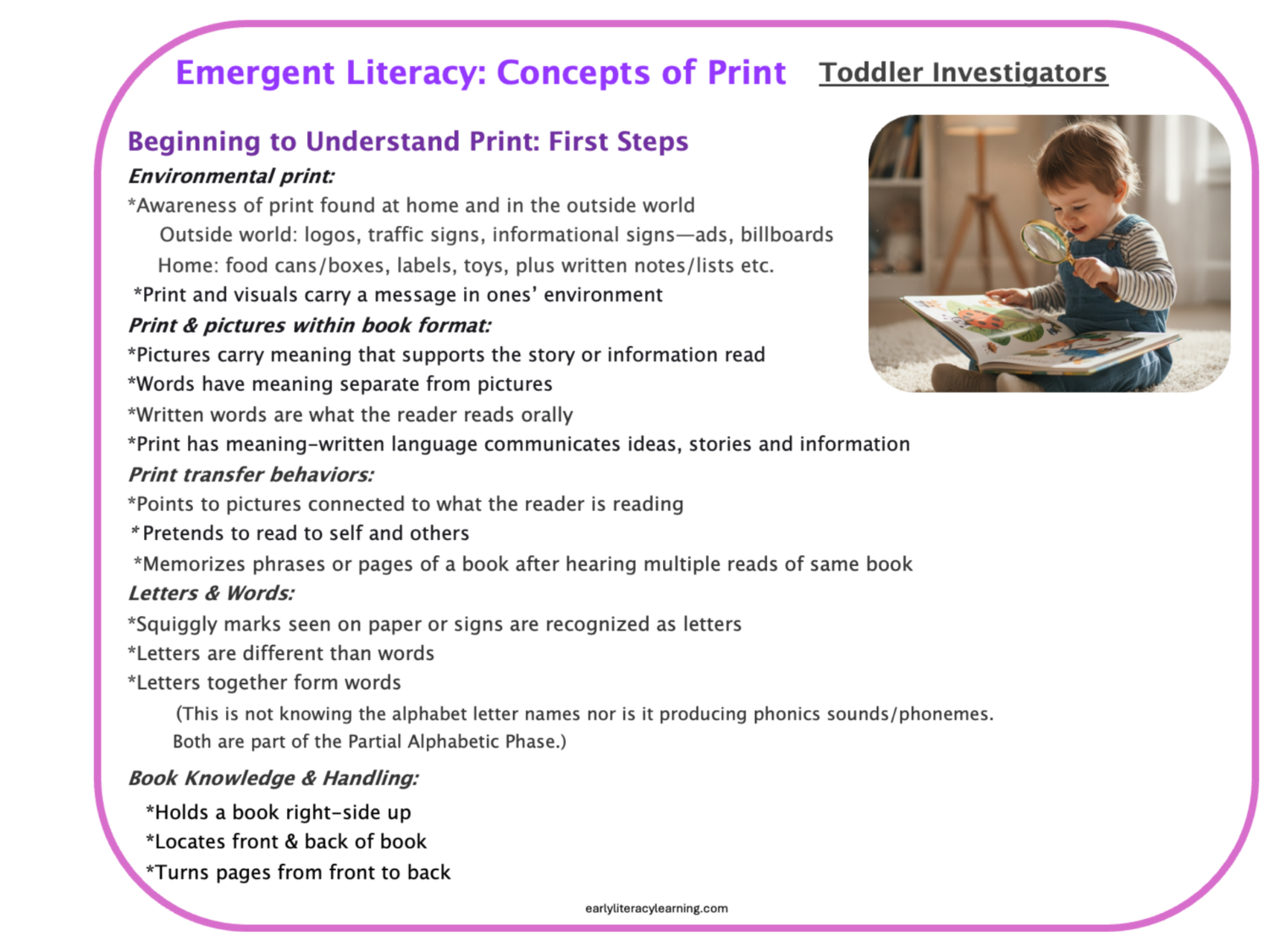
The visual below divides the concepts of print for toddlers into five categories. This is not a sequence of skills since many of them are learned at the same time. Also, some will not be obtained until after age of three. A higher probability occurs for a toddler to begin to acquire these skills by providing daily shared interactions in a print-rich environment. Other key factors are the length of their attention span and interest level. Both will change as the child becomes older and has more experiences with print.
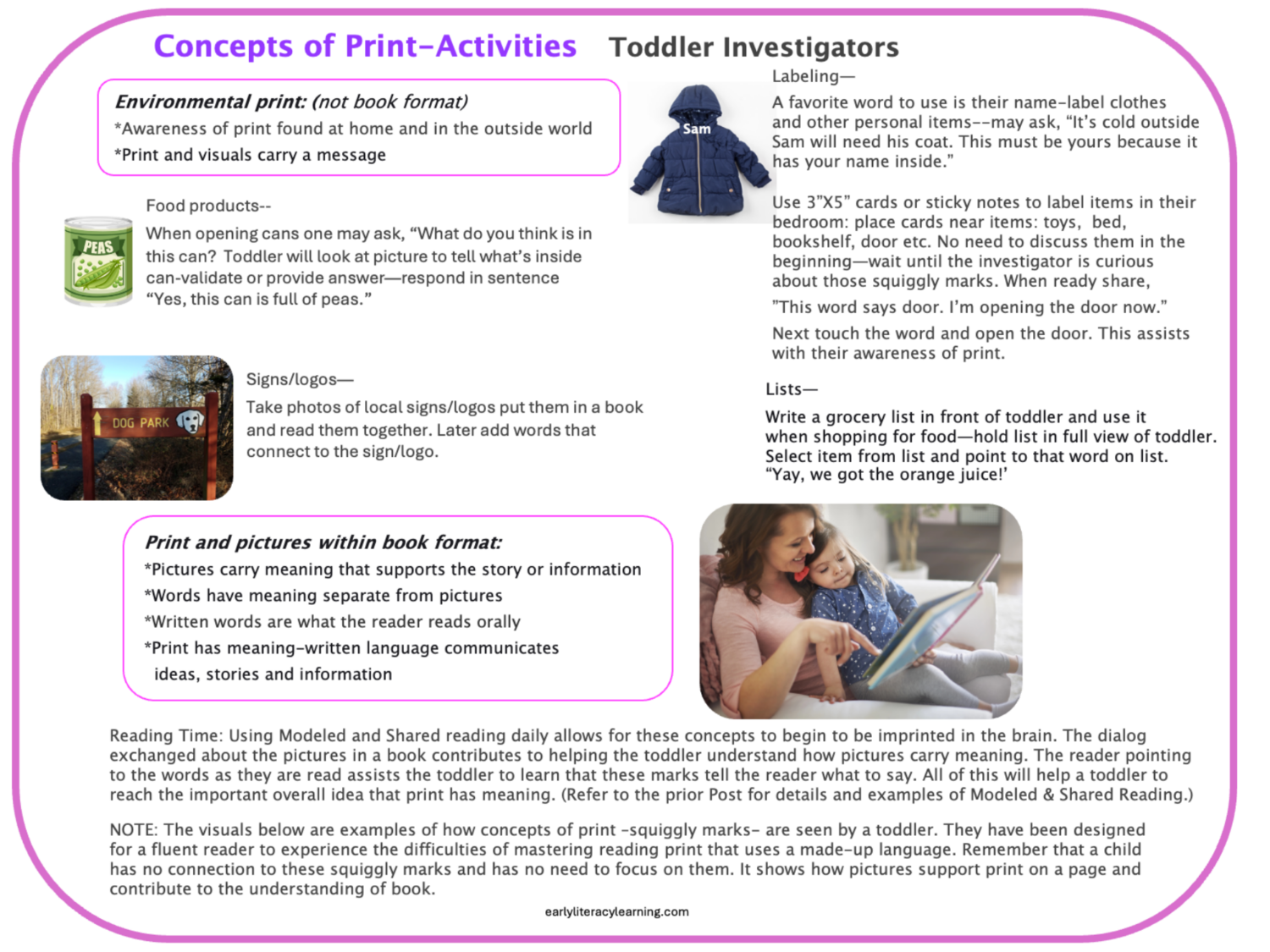
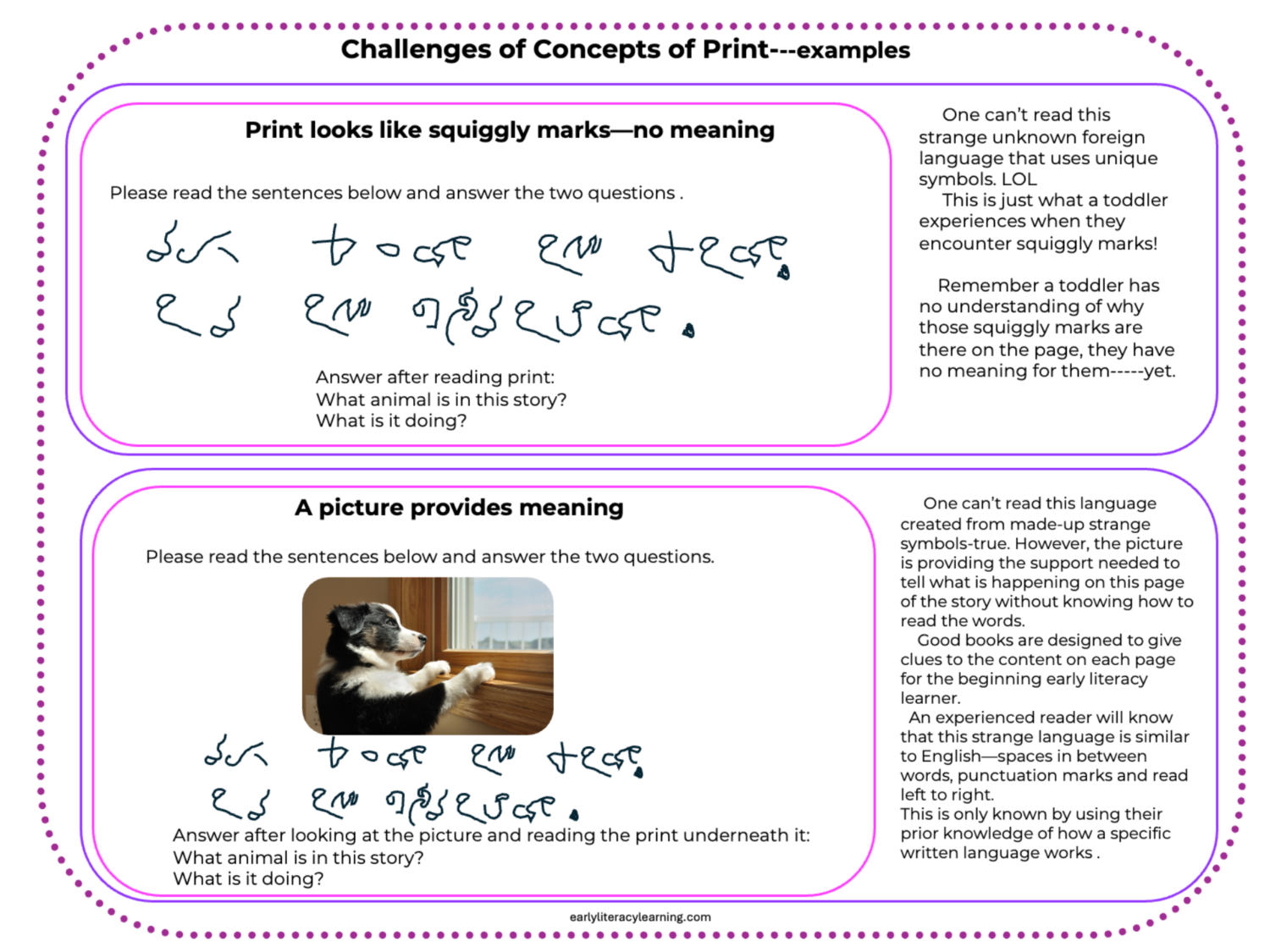
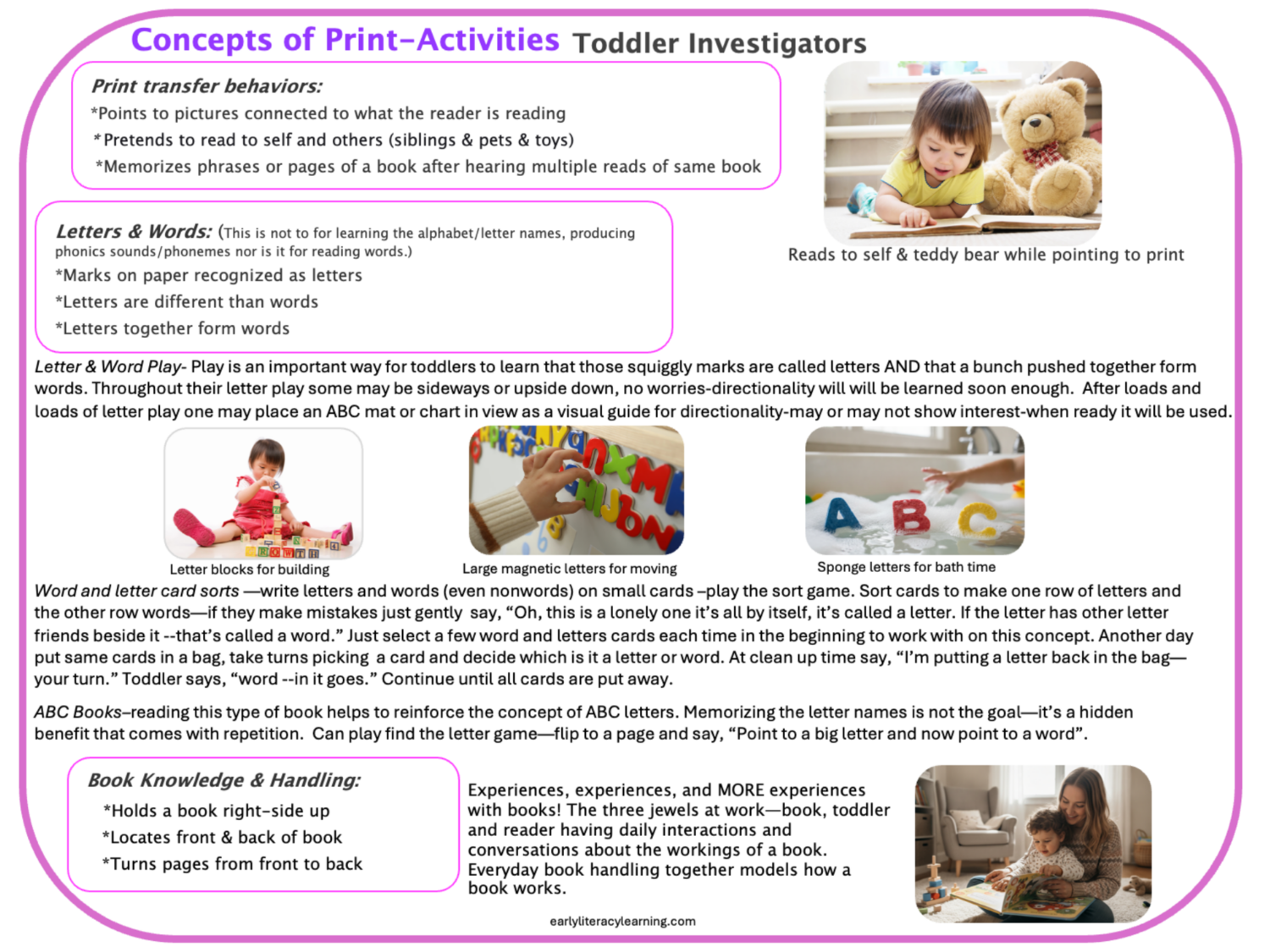
Emergent literacy starts off with an abundance of oral language connections laying the foundation for the literacy learner, blended together are these important aspects: phonological awareness, listening & speaking, vocabulary development and book & story concepts. When ready, the beginnings of reading and writing readiness become a welcome challenge for a toddlers’ brain as the world of print becomes their new frontier to investigate.
The visual below is an overview and shows the key elements needed to conquer the new frontier of the printed word in reading and writing. English is a complicated language having 26 letters and 44 letter sounds-phonemes. PLUS, there are multiple ways to write many of these sounds (graphemes) for example: long a sound may be represented by — ai pail, ay day, a-e cake, ei vein all are using different letter vowel groupings for long a sound and are read and pronounced in the same manner.
(This post addresses reading while the following post will discuss emergent writers/spellers.)
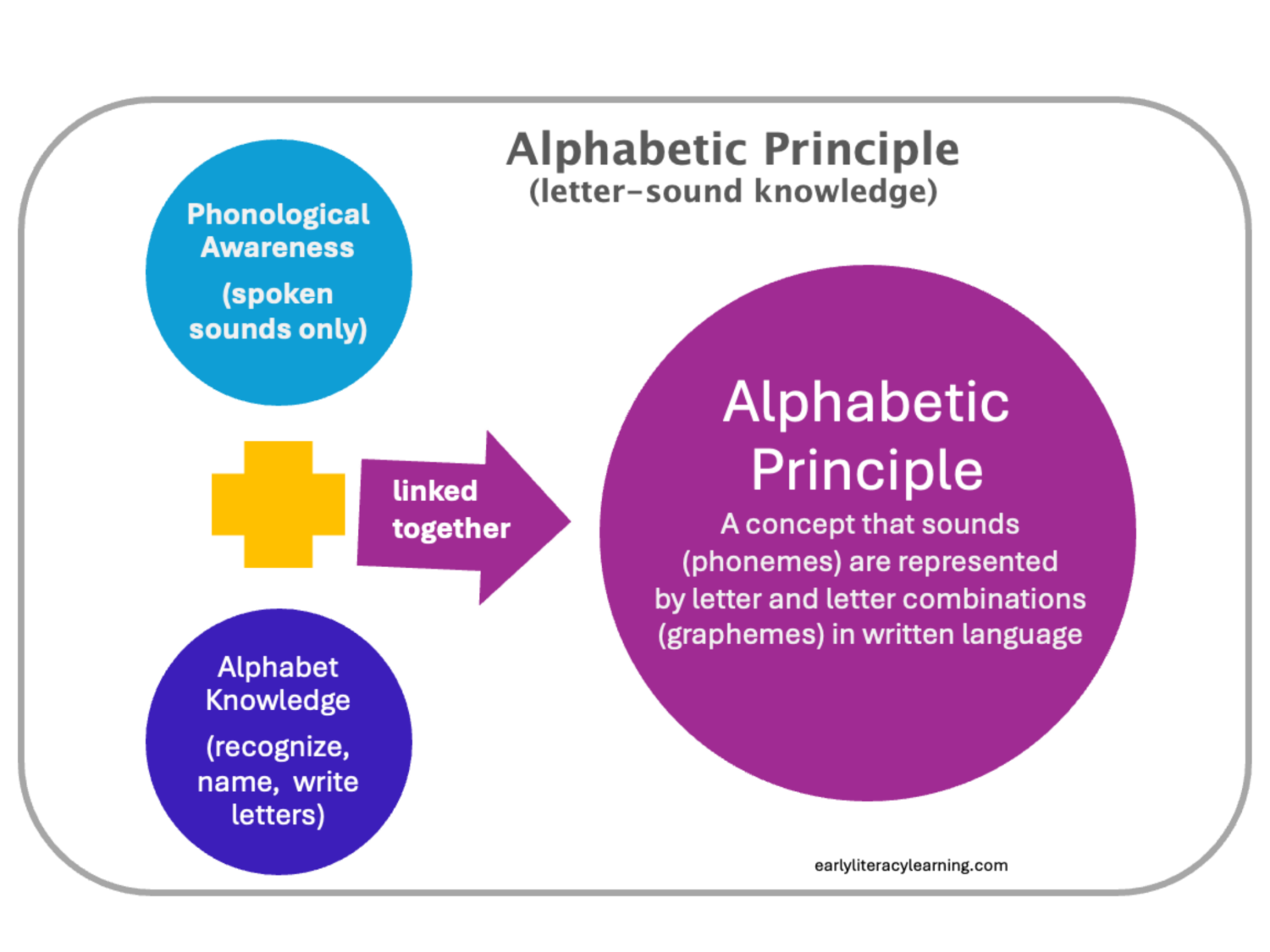
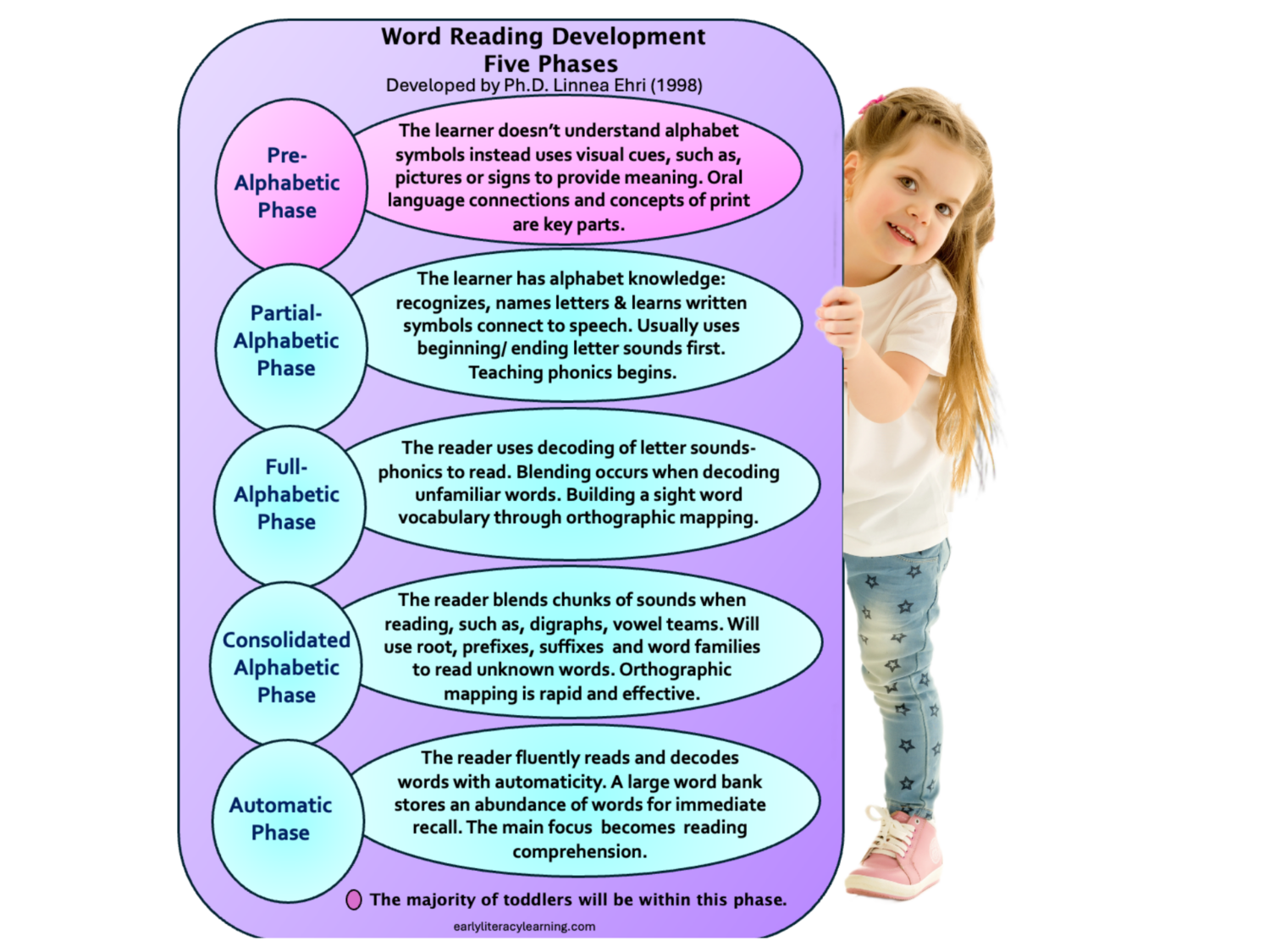
The Alphabetic Principle is a cognitive process that includes skills needed to become a reader. It is an essential driving force for successful readers. Dr. Ehri a renowned cognitive psychologist created the five phases of word reading development after years of scientific studies on how children connected letters to sound or the Alphabetic Principle. She developed her work using four phases, however, a fifth phase was added later and followed the original first four.
The Alphabetic Principle is a concept that speech sounds (phonemes) are represented by a letter or letter groupings (graphemes) in a written language. Her work helps to identify and clarify how a child learns to become a proficient reader of words. Although the five phases do have a sequence in their presentation—this is not a one size fits all approach. The phases are fluid not rigid–meaning a child may be in more than one phase at a time.
Toddlers start off in the pre-alphabetic phase. Some may move into the second phase since it includes alphabet knowledge and phonemic awareness. Alphabet knowledge is being able to recognize and name upper & lower case letters along with writing each one. Some toddlers may learn the name of a few letters. Phonological awareness plays an important role in helping a child ready themselves for the second phase.
Ehri’s Word Reading Development Phases (first two phases)
Pre-alphabetic phase one
In this phase the learner does not understand alphabet symbols instead uses visual and contextual cues-(signs, logos etc.). Parts of concepts of print are found within this phase, an essential aspect would be environmental print. Phonological awareness is introduced by using rhyming, alliteration and other auditory skills.
Partial-alphabetic phase two
Phonemic awareness is part of this phase with special emphasis on phoneme substitution, segmentation, and blending.
Alphabet knowledge is an important aspect of this phase-recognizing and naming 26 letters-upper & lower case, beginning to learn spoken sounds-(phonemes) are connected to written print (graphemes) starting with beginning & ending consonant sounds, and letter forms – learning how to write the letters of the alphabet.
It’s the start of phonics. Decoding which is the understanding of letter-sound relationships and encoding learning to write/spell sounds begins.
In this phase a child is continuing to learn the basic sound-symbol correspondences and their predictability.
The visual below shows all five phases—showing the progression of word reading development.
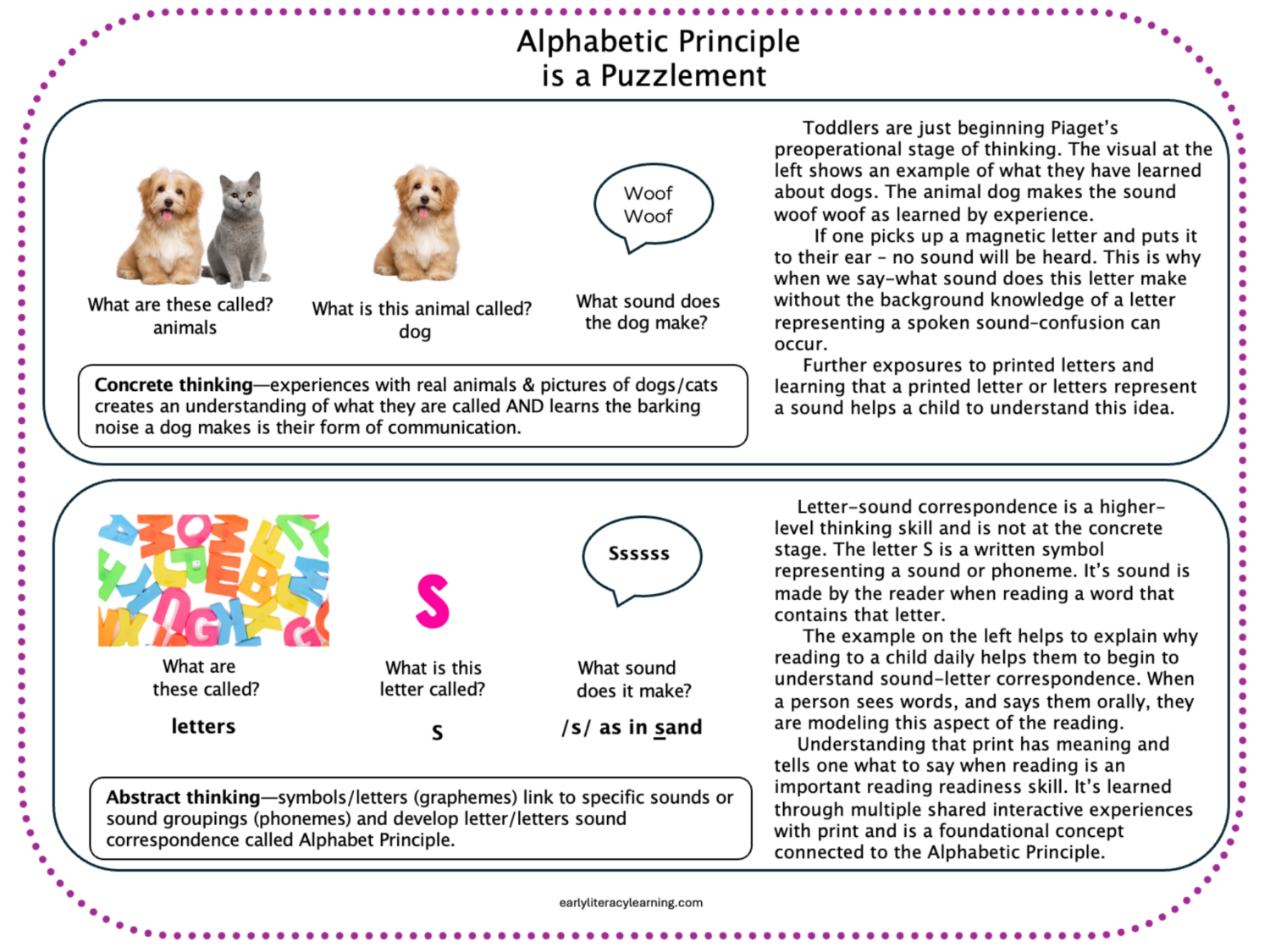
The future reader has an abundance of ideas to internalize, and concepts of print is one of their starting points. Knowing that those squiggle marks represent a written language and has meaning takes daily interactions with print inside and outside the home. Having an understanding of how the mysterious thing “book” works is an essential part too. These print investigators are getting ready to tackle even MORE throughout their pre-readiness emergent literacy stage and taking beginning steps towards learning about the Alphabetic Principle. How exciting!


A reminder to not become overwhelmed with worry about all the pieces of concepts of print. No, instead realize that through Modeled & Shared daily reading, hands on activities, conversations about environmental print a toddler will obtain these concepts and will be on their way to understanding the Alphabetic Principle. Just have fun learning together!
Happy days to you,
Kylene
“Children are like flowers. They all bloom at different times and in different ways.”
Maryln Appelbaun, author

Resources & References
Brightwheel Childcare, (2025), Print Awarreness: A Complete Guide for Early Childhood Educators, https://mybrightwheel.com/blog/print-awareness
Littles Love learning, (2022), What is the Alphabetic Principle? Information for Preschool, Pre-K & Kindergarten Parents & Teachers, https://youtu.be/whUsMYCRK-c?si=g34XHFXu8gQcIxPh
Mesmer, Heidi A., Leader Reading Specialist, (2024), Ehri’s phases of word recognition, https://www.youtube.com/watch?v=d3WAiveXUiI
Otto, Beverly, (2019), Literacy Development in Early Childhood, Waveland Press, Inc.
Reading Rockets, (2009), Becoming Aware of Print, https://youtu.be/2Yti78OGxg0?si=_4t-qGS8KOwcxNSr
Wright, Tanya S., Cabell, Sonia Q., Duke, Nell K., Sout-Manning, Mariana, (2022), Literacy Learning for Infants, Toddlers, & Preschoolers, Publishers NAEYC Washington DC
Explore More about Reading Time Investigators